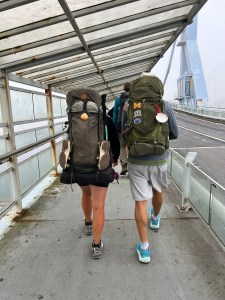
I’m not an expert on backpacks, so you may want to search the Internet for others’ advice, but here’s what I’ve learned during my time on the Camino:
Get a backpack that is sized for you
Most backpack models come in multiple sizes (e.g., small, medium or large). Of course, you’ll want to pick one appropriate for your body type. The best way to do this is to try them on at a local outfitter.
Note, some models come in one size, but can adjust for different body sizes. For example, my pack has a plastic frame that can shortened or heightened to the appropriate size.
No matter what you get, have a local outfitter help you adjust your bag to get it set-up just right for you.
Choose the right capacity
Backpack capacities are usually measured in liters.
Smaller day packs (like school backpacks) are about 10-20 liters.
Backpacks for through-hikers on trails like the Appalachian Trail are often 60 liters or more. Of course, they have to carry tents, days of food rations, and special hiking supplies.
In my opinion, the sweet spot for the Camino is around 35-40 liters. That’s big enough to carry the essentials, but not so big that you can carry a bunch of extra stuff.
Personally, I carry a pack with the capacity of 36 liters.
FWIW… There are pilgrims out there that carry very small packs of about 20-25 liters. This subset of the community prides itself on carrying as little as possible. This is the exception, not the rule. Most people that I know find this size too small for a pilgrimage on the Camino.
Which brand and model?
There are a ton of companies that make good backpacks with all kinds of features. There is so much choice that it’s overwhelming.
If it helps, the most popular brand I’ve seen on trail is Osprey, and that’s what I use. The lightest bags are made by Hyperlight, but those cost a bit more. I’m not knowledgeable enough to recommend vendors and models, but those two companies might be a good place for you to start your search.
My pack is the Osprey Stratus 36. A couple of features I like about this pack are it’s frame, which lets air circulate along most of my back, and a side access zipper which makes getting things in and out of the pack very easy. Here’s REI’s web page for this pack.
For my daughter and daughter-in-law, I purchased the Osprey Kyte 38. It’s a woman-specific model, and I figured they’d appreciate a couple more liters of space for gear. They walked with these packs in 2025, and they worked well. Here’s REI’s web page for that pack.
Have a professional adjust your bag for you
Once you buy your backpack, have a person at the store adjust it for you.
Then, a month or so before your Camino, take your fully loaded bag back to the store, and have them adjust it again, just to make sure everything is right.
I took mine to REI twice before my first Camino, and they were always happy to help.
Should I get a water bladder in my backpack?
Bladders make it easy to drink while you are hiking and can hold a lot of water, and many people swear by them. The downside is they are challenging to clean, add some weight, and sometimes can be difficult to fill on the trail.
For the Camino, instead of a bladder, my recommendation is to use a bottle with a straw that is mounted on the front of your bag with a sleeve. This will make it just as easy to drink from, but won’t be as difficult to clean as a water bladder. The only downside of this approach is that bottles won’t be as big as a bladder, so you’ll need to refill them more often. Fortunately, there are plenty of places to refill bottles on most of the Camino routes. (During extremely hot spells, in addition to my normal bottle, I’ll buy a bottle of water at the store, and put it in a pocket of my pack. That way, if I have difficulty finding a fountain on the trail, I can still refill my main bottle at least once.)
To mount a bottle on your bag, you’ll need to purchase a sleeve for your backpack. This one has worked for me. Unfortunately, it’s stupid expensive ($30). It should be half that. That said, I use it because it’s the only one that I have found that is comfortably wide-enough to hold wide sports bottles. The other sleeves I’ve looked at (example) seem to be designed for taller skinnier bottles.
FWIW… A bottle without a straw packed in a side pocket of your pack will work too, but you’ll find it can be awkward to take out, and you won’t drink as much as you would if you had a straw near your mouth that’s easily reachable.
 Bill on the Camino