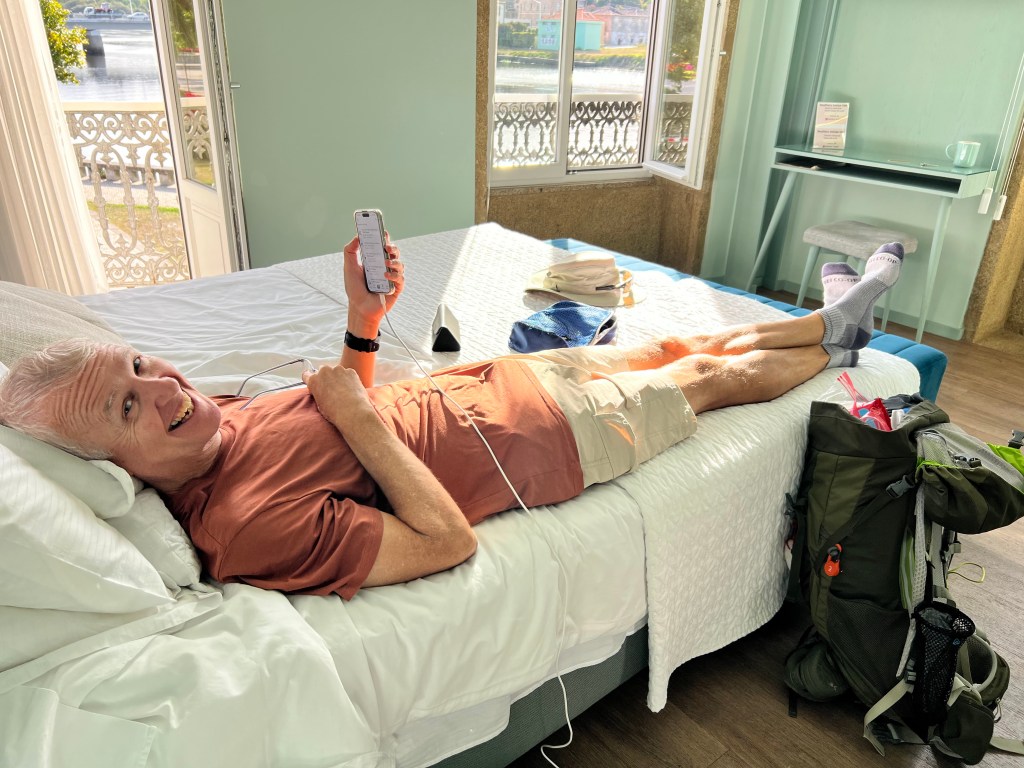
There are two decisions you’ll need to make with regards to lodging when you walk the Camino:
Q1: Do you want to book your lodging ahead of time, or just find a place to stay each evening?
Many pilgrims find that not booking their rooms ahead of time provides them the most flexibility, and also provides them the most authentic pilgrim experience. Each day, they just walk as far as feels comfortable, and then they stop. Of course, the only downside to this is that sometimes, especially in busy seasons/locations, there may not be a room, so you’ll have to keep walking. Because of this, you’ll find some pilgrims wake very early each morning and “race” to the next town to claim their space.
Many (if not most) pilgrims swear to this approach, but it never appealed to me, so I have always chose to book ahead.
Booking your lodging will give you peace of mind that you have a place to stay, but it also creates a fixed schedule, which means it’s harder to adjust when something goes wrong (like you get hurt or can’t walk as far as you thought).
Q2: Do you want to stay in dormitory-style lodging or a private room?
Dormitory-style housing provides the most social Camino experience. You’ll share communal meals with many different people, and you’re most likely to build close relationships. The trade-off, of course, you’ll need to put up with snoring, shared bathrooms, and noisy pilgrims waking you up in the morning.
I’m a snorer, so I almost always stay in private rooms. That said, there are a few iconic places along the Camino that are dormitory-style, so I’ll often stay at one or two of them each of my Caminos.
If you choose to stay in private rooms, you’ll need to work a little harder to get to know people. You’ll meet people on the trail, so use those opportunities to chat. I met hundreds of people this way, and I built many very close relationships, but I had to be a little more intentional than the people that were staying in the dormitory-style lodgings.
Most private rooms along the Camino will be comfortable but not fancy. You won’t be staying at chains like Holiday Inns or Hilton. You’ll be staying mostly in mom-and-pop establishments. Rooms and bathrooms will be small by American standards. But on the Camino, it will feel like a treat.
The Lodging Options
The table below is a summary of al the lodging types I’ve seen on the Camino. I list them from least expensive to most expensive, although there can be great variation in each category, and categories cross over.
| Type of Lodging | Description |
|---|---|
| Municipal Albergue / Gite d’Etape / Hostels | Dormitory-style. Very inexpensive ($10-$20 per night). Often included a communal meal option. Often don’t allow you to book them ahead of time. |
| Private Albergue / Gite d’Etape | Identical to the Municipal Albergue listed above, but run by a family or business owner. Often a little nicer than the municipal options and priced higher as well ($15-30 per night). Often allow you to book them ahead of time. |
| Casa Rural / Pension | Usually a family run establishment with private rooms. Sometimes meals are available. ($30-50/night). |
| Housing above Restaurant or Shop | Many restaurants will supplement their income by renting private rooms above their establishment. These are usually moderately priced ($40-$60/night) and sometimes come with meals. Usually has private bathrooms. |
| Hotel | What you would expect, a business catering to travelers. Often has a front desk. Private rooms. Prices and quality vary widely. One-star type hotels may only be $30-$40 a night, and may be all that is available in some towns. Four-star hotels will be over $100. |
| Bed & Breakfast / Chambre d’hôte | Small establishment run by a family. Often involves personal/friendly service. Almost always includes breakfast, and sometimes dinner. Rooms are always private, but occasionally share a bathroom. Prices vary. |
| Apartment / Home | Think AirBnB. Prices are a little higher, but often include nice features like a washer and/or dryer. Works the best if you’re walking with other people. Prices vary. |
| Parador / Luxury Hotel | Four-star expensive hotels. Doesn’t feel like pilgrimage but can be a fun treat during an otherwise austere pilgrimage. Expect to bay $150 or more. |
How to book lodging ahead of time
Option 1: Booking.Com
- Many European lodging establishments are available on Booking.com. I use this sight to book about two-thirds of my rooms. The sight is easy to use, and importantly, all my reservations are in one place and easy to find. Almost always, you can book rooms ahead of time with free cancellation and no money down. Often though, there is no cancellation one or two weeks ahead of the stay. Please note, Booking.com may show that a particular lodging is full. Don’t believe it. Many places only put a subset of their rooms on Booking.com due to Booking.com’s high fees. The lodging often holds back rooms for people who book with them directly.
Option 2: Book on the establishment’s website
- Larger or better managed sights will often have their own website where you can reserve a room. You’ll get an email confirmation after reserving. Like in the US, most of these sights may ask for a credit card to reserve, but almost always you can cancel up to a day or two in advance. I have had some places request a small deposit (30€ or so) via PayPal or occasionally a bank transfer.
Option 3: Contact establishment via phone or email
- Some small places don’t have a meaningful web presence. The only way to book is by emailing them or calling them. I always use email, since I don’t speak any other languages than English, and I like written confirmation of my reservations. 95% of the time this works great. They’ll get back to me, tell me the price, I’ll agree, then they’ll send me confirmation. About 5% of the time you won’t hear back from the lodging. Either I have an old email address, or they never check it.
My process for booking rooms
I’m an obsessive compulsive planner. It comes from a 40-year career in Information Technology. I love to plan. So here’s how I do it:
- Plan out my route and identify what towns I’d like to stay in.
- Use Google Maps and Booking.com to find the lodging opportunities in each town. I try to find a place in the middle of the town close to restaurants and stores. If there is an “old town” as part of the city, I try to stay there. I read reviews, and in particular, I try to select places that other pilgrims tend to stay.
- If possible, book the selected lodging on Booking.com.
- If not, then book selected lodging on the lodging’s website.
- If none of those options are available, I send email to the establishment to book.
- Very rarely, unless I’m sure they speak English, do I actually call someone.
I book rooms much earlier than other people. Usually 8-10 months in advance. That’s not necessary, but I would recommend booking a few months in advance. If you want to stay at one of the iconic Camino-famous places (e.g., Orison, Borda, Casa Fernanda, Casa Suzi), then you may want to try to book that way ahead of time. They fill up very early.
 Bill on the Camino