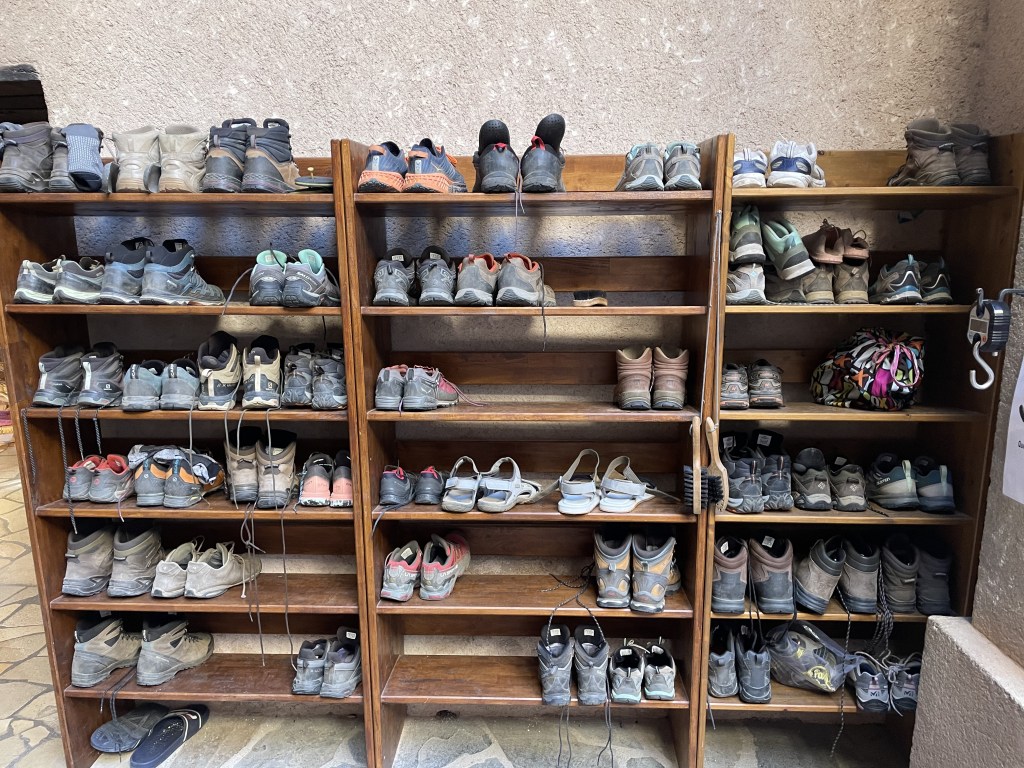
What shoes should you wear on the Camino?
There are countless correct answers to this question, and members of online forums have been debating this for years. Here are my recommendations:
You don’t need hiking boots.
If you love hiking boots, wear them, but they aren’t needed. This isn’t the A.T. or P.C.T.. You won’t be forging rivers or climbing over boulders. Nearly every trail will be decently maintained, and you’ll walk on pavement quite a bit. With only a few exceptions, footing will be good, so a lighter more comfortable shoe will work.
Trail runners are your best bet.
All of my close Camino friends, and the majority of pilgrims that I meet, wear some type of running/walking shoe. Many choose “trail runners” which feature well cushioned soles and heavy treads that work well on dirt and rocks.
The brands I have seen the most are Hoka, Altra and Brooks, but nearly every major brand has several models from which to choose.
Get larger wider shoes.
Day-after-day of walking will definitely result in your feet swelling. As a result, shoes that fit fine in your normal life will cause blisters on the Camino.
There are two ways to mitigate this.
First, buy shoes that are a half a size to a whole size larger than you usually wear. I usually wear size 11 shoes, but I purchase 11.5 for the Camino.
Second, buy the wide version of the shoe you intend to wear, or buy a model that is designed with a very wide toe box. (Altra shoes are known to be especially wide.)
I train more for a Camino than most of you ever will, and I still ran into the problems of shoes not being wide enough once I’m on the Camino itself. Don’t presume you’re the exception to the rule. Get a wider model than usual.
Bill, what have you worn on your Caminos?
On my first Camino I wore Hoka Speedgoat 5.
On my next two Caminos, I wore Altra Olympus 4 & 5.
I liked all these shoes, but unfortunately, none of them proved wide enough for me. I trained for months with no issues but after a week or two walking on the Camino, I had rubbing on my pinky toes that caused irritation. Each time, I cut a little slit in the side of the shoe to give my toes extra room, and it fixed the problem.
I’m my fourth Camino, I work Hoka Speegoat 6.
These worked better than the earlier version. I did get some rubbing on my toes, but not nearly as much as I had on earlier pilgrimages.
While I have preferred Hokas and Altras, you’ll see many brands of shoes on the Camino (e.g. Brooks, Saucony, Topo). Any of them can work well, and will depend your foot, stride and personal preference. Try a couple during training, then use the one that works best for you.
Waterproof shoes are not needed.
I’ve never worn waterproof (e.g. GoreTek) shoes on the Camino, but I’ve read a number of posts by pilgrims that did. While some swear by them, the general consensus is that it’s not needed and can even be a mistake. They are warmer than normal shoes, which cause your feet to sweat more, and in heavy rains, they don’t keep your feet dry anyway.
My recommendation… Save the money, don’t get waterproof shoes.
For what it’s worth, when your shoes do get wet, you can usually get them reasonably dry the next day by airing them out all night. One technique used by hikers is to stuff them full of paper as they dry. The paper absorbs the water and accelerates the drying process.
Bring a second pair of shoes for walking around town.
Once you reach your destination for the night, it’s a good idea to let your hiking shoes dry out (from sweat or rain), and also give your feet a break from being confined. Every pilgrim that I’ve met brings a second pair of “town” shoes that are comfy and airy that they can use for walking around town.
There are two types of town shoes that I generally see people wearing… Crocs or sandals (Tevas). I wear Crocs since they weigh about half what a pair of good sandals weighs, but I know others who really like their sandals and even hike in them when their feet need a break from their shoes.
 Bill on the Camino