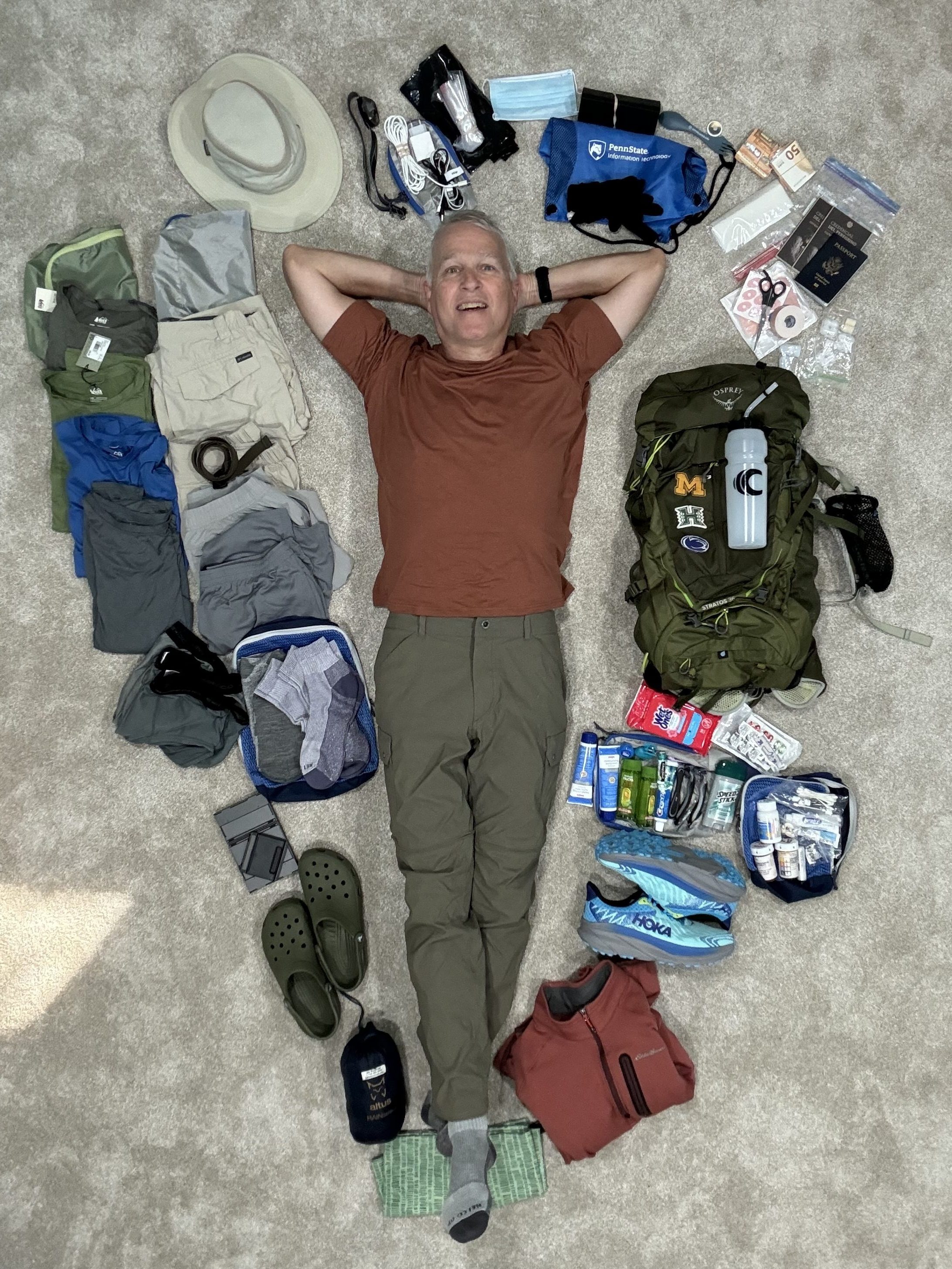
How much you should carry with you on your Camino will vary on several factors, including:
- What time of the year are you walking?
- How long is your Camino?
- In what type of lodging will you be staying?
That said, here are some general suggestions on selecting your gear for the Camino:
Suggestion #1: The 10% Rule
“I didn’t bring enough” said by no pilgrim ever.
There is a generally-accepted rule that your fully-loaded backpack should weigh no more than 10% of your body weight. This isn’t a hard-and-fast rule, since body types are so different, but it is a helpful way to give each walker a target for what they should carry.
I recommend that new pilgrims try to stay as close to the 10% goal as possible. If you’re a pound or so off, it won’t be the end of the world, but if you start going much higher, your hike will be harder, and you will increase the chance of problems with your feet, legs and back.
Suggestion #2: Absolutely no cotton
Cotton is heavy and dries slowly, terrible characteristics for hiking. Instead carry synthetic or merino wool clothes specifically designed for travel. This goes for everything. Socks. Underwear. Pants. Shirts. Outerwear. PJs. Towel.
Suggestion #3: They have stores in Europe
If you’re debating if you need something in your pack or not, remember, you can always buy things on the trail. You will find pharmacies, markets, and convenience-type stores in nearly every town. You will find sporting goods and department stores in the larger towns. You can buy what you need.
Suggestion #4: Two or three sets of clothes is enough
Most pilgrims hand-wash their clothes every night. So, having just 2 or 3 sets of clothing is fine. You’ll always have something clean. If you want to bring anything extra, more underwear or an extra pair of socks is fine, but don’t load up on clothes unless you’re able to keep the rest of your bag really light.
I generally walk in August, September and October. Here are the clothes I usually bring with me. (Vendor/models are provided as an example, not as an endorsement.)
- 3 short-sleeve tee shirts of varying color (REI Sahara Short-sleeve T-Shirt)
- 1 long-sleeve tee shirt (REI Sahara Long-sleeve T-Shirt)
- 1 synthetic fleece (Eddie Bauer First Ascent Synthesis Half-Zip Fleece)
- 1 pair of zip-off long pants (Columbia Silver Ridge Convertable Pants)
- 1 pair of zip-pocket gym shorts (zip pockets are ideal, so I don’t lose anything on the trail)
- 1 pair of comfy gym shorts to sleep in (but can wear around, if necessary)
- 3 pairs of underwear (Ex Officio Briefs)
- 3 pairs of socks (REI Coolmax Lightweight Hiking Quarter)
On my first Camino, I carried one less short-sleeve tee shirt and one fewer pair of shorts, which worked fine. Having more clothes is a luxury, not a requirement.
Suggestion #5: Handle the cold with layers, not a coat
Bringing a heavy jacket or sweater on the Camino isn’t practical. They are just too heavy and bulky, and other than in winter, they aren’t really needed. Instead, if you get cold, you can always layer the other clothes that you have.
On very chilly mornings, I wore a short-sleeved tee shirt, a long-sleeved tee shirt, and my synthetic fleece. I then peeled off layers as I went along. I hate being cold, and this worked fine for me.
Suggestion #6: Packing cubes are your best friend
I can’t imagine using a backpack without packing cubes.
Loading your pack with a bunch of loose items can be a real mess. I far prefer to use 5 or 6 packing cubes for my gear. With packing cubes, everything is organized, and it’s so easy to grab what you need even when you’re out on the trail.
The only significant things I don’t put in packing cubes are my fleece and rain poncho.
Here’s an example of packing cubes you can purchase, although cheaper options exist. I’d recommend getting five or six cubes. A couple big ones, a couple medium ones and a couple small ones will probably work well.
Here’s how I use them:
- Large … Clean clothes
- Large … Dirty clothes
- Large … Miscellaneous stuff that I don’t use every day (e.g., headlamp, battery charger, spork, laundry soap). Since these items are used less often, I stick this bag at the very bottom of my pack.
- Medium … Toiletries
- Small … Electronic cables, chargers, keyboard, etc.
- Small … Medications and blister supplies
Suggestion #7: Bring enough prescription medicines for your whole trip
While pharmacies are easy to find in Europe, getting prescription drugs may be more difficult. Make sure you bring enough of your prescription medicine to meet your needs over the whole Camino.
As for non-prescription medicines (e.g. Mortrin), I usually bring a small amount of these with me, then purchase more if I need them.
Suggestion #8: Your lodging choice determines what bedding you will need to carry
Unlike most pilgrims, I book private rooms for my Caminos. Private rooms always come with bedding and towels, so there is no need for me to carry any of these things with me. This saves me a lot of weight.
If you’re staying in albergues, carrying a sleeping bag liner and a quick dry towel will likely be necessary. Many albergues can provide you sheets and towels (sometimes for a fee), but you’ll want to make sure you have something just in case.
Carrying a sleeping bag isn’t usually necessary unless you’re going during a cold month.
Suggestion #9: Wear sun protection
Sun hat, scarf and/or neck gaiters are a must when walking in Southern Europe.
Sunscreen is commonly available in stores, so plan on buying some when you arrive in Europe. I usually bring a 3-ounce bottle of sunscreen with me to start, then buy more after I arrive.
Suggestion #10: You may want to bring this stuff too
Here are some of the less obvious items that I bring with me on Camino:
- Baggies. You’ll be carrying food on the Camino, so having 6-8 ziplock baggies of various sizes always helps.
- A large garbage bag. One technique to avoid bedbugs is to store your backpack in a garbage bag at night. It helps ensure no bugs climb into your bag. It also can be used to wrap your backpack in the case you need to check it on the flight home.
- A laundry line. After hand washing, it’s nice to be able to hang clothes next to an open window or on a balcony.
- Spork. Helpful when you’re eating on the trail or in your room.
- A bag to carry your stuff in town. In the evening, you may want to carry your valuables with you when you go out to dinner. I have a lightweight string backpack that I put everything in so I can safely carry things with me.
- Washer/Dryer sheets. You can use shampoo or soap to wash your clothes in the sink, but washer/dryer sheets are useful if you find a laundromat. The washer sheets can be used in the sink for washing too.
- Kleenex/Wet wipes. Helpful for personal hygiene, and a nice backup when you aren’t sure about your bathroom options on the trail.
Suggestion #11: Carry your bag on the airplane
I generally check my luggage when I travel, but not on pilgrimage. After I spend a couple of months carefully putting together all the gear that I need, I don’t want to end up losing my bag and having nothing at the start of the Camino. Replacing everything in a day or two would be nearly impossible.
Since you’ll be carrying-on your luggage that means you’ll need to follow TSA rules. No liquids greater than 3 ounces.
TSA does not allow walking sticks to be carried onto a flight (although occasionally they get through). Many pilgrims buy a new pair when they arrive in Europe. If you really want to bring your walking sticks, pack them in a separate container that you can check, then carry-on your pack.
If you fear you may have to check your bag because it’s too big for the overhead (or some other reason) here are two ideas to mitigate risk:
- Bring a large disposable shopping bag to the airport with you. Take all of your packing cubes out of your backpack and put them in the shopping bag. Carry-on the shopping bag. Check the empty backpack. The packing cubes should fit well in overhead storage or under the seat in front of you. If your backpack is lost, then it’s the only thing you’ll need to replace. That should be pretty easy to do in a large city before your Camino.
- Bring a large plastic garbage bag to the airport with you. Put your backpack in the garbage bag and tape it up before checking it. Make sure it’s labeled well. Having the backpack in a plastic bag will ensure loose straps don’t get caught in conveyer belts.
My Standard Packing List
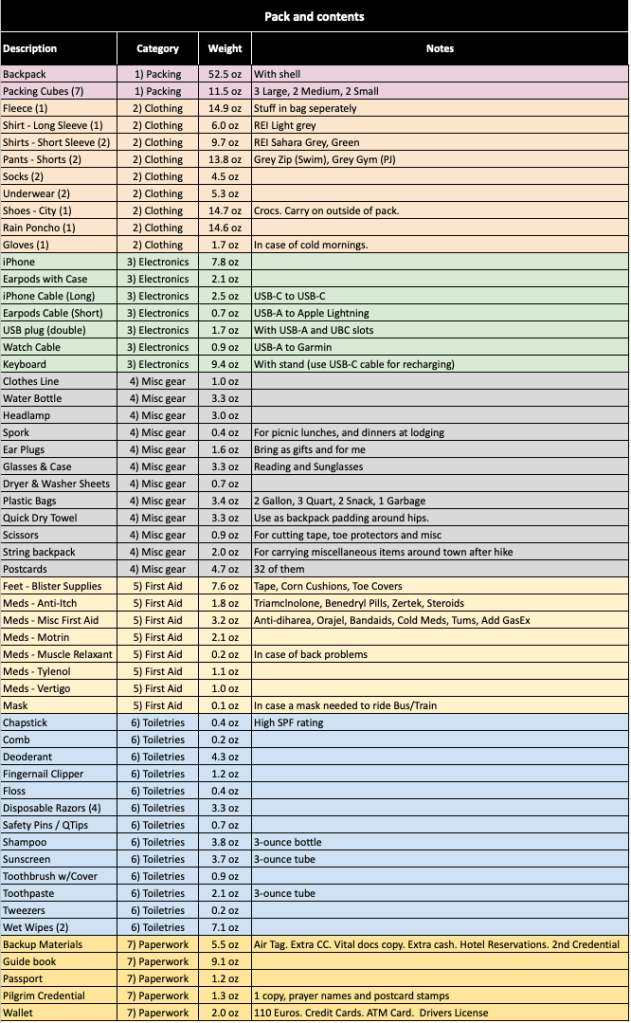
Here’s everything I usually carry on Camino.
Keep in mind, all of my Caminos have been in August, September and October so weather is generally mild, but gets cooler at the end.
My goal was a bag that weighed 17.5 pounds. These items weigh in at 16.6 pounds.
While this is everything I need, when I’ve done my hikes, I have often added other things like an extra shirt, extra shorts, a battery charger, and rain socks taking the total closer to 19 pounds. In retrospect, the items on this list below were more than enough, but a couple of extra pounds was not an issue for me.
I don’t include the clothes on my back in my backpack weight count, so those are listed separately. Therefore, when you see two short-sleeve tee shirts in my list, I really have three, because I’m wearing one.
I also don’t include water and food in my count, which probably adds 2-3 pounds to the total. Some hikers think this should be included in your 10%, but I don’t include them.
You can see from this list that I measure every item in my bag. I recommend you do the same. You’ll make wiser decisions when you know exactly what everything weighs. A small kitchen scale will do the trick. When your bag is totally full, weigh again to get your final pack weight (the list isn’t as accurate since there is rounding taking place on each item).
The clothes on my back (not included in total):

 Bill on the Camino